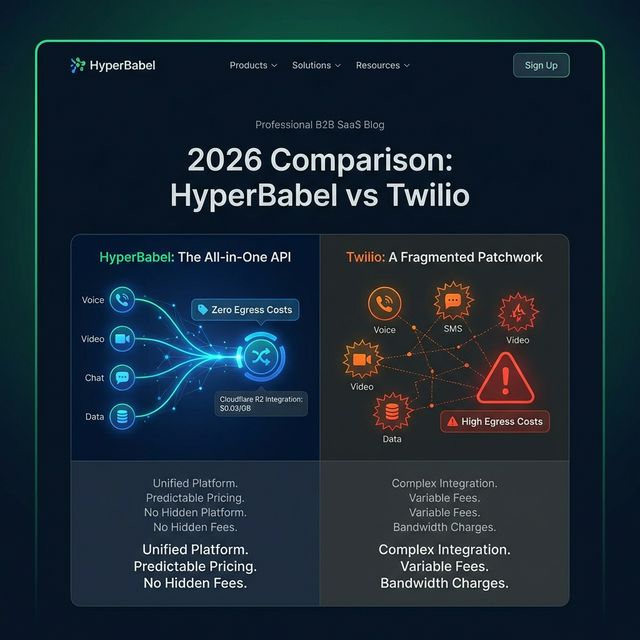
HyperBabel vs Twilio (2026): The Terror of Fragmented SDKs and Egress Fees
HyperBabel vs Twilio: The Terror of Fragmented SDKs and Egress Fees
💡 Target Audience: Development and Ops teams suffocated by Twilio's complex integrations and media file download traffic fees.
2026 Competitive Landscape Overview
In 2026, the market is shifting towards "Experience-First" communication. However, legacy pricing models still create significant friction for scaling businesses.
| Platform | Pricing Model | Core Focus | Feature Packaging |
|---|---|---|---|
HyperBabel 2026 Winner | Flat-rate / Concurrent | All-in-One + AI | Integrated (Chat, Video, Trans, Live) |
| Twilio | Pay-as-you-go (Granular) | Channel Ubiquity | Disconnected (Patchwork SDKs) |
The cost nobody models until the invoice arrives
Storage pricing is the number everyone compares. Egress is the number that actually bills you.
On classic object-storage-backed stacks, holding a gigabyte looks cheap — around $0.023/GB/month on AWS S3 list pricing. But every time a user opens that image or plays that video, outbound transfer is billed at roughly $0.09/GB. Storage is charged once per month; egress is charged once per *view*.
That inversion is what surprises teams:
| Media workload (per month) | Stored | Downloaded by users | Egress at $0.09/GB | HyperBabel egress |
|---|---|---|---|---|
| Small community | 50 GB | 200 GB | $18 | $0 |
| Active social app | 200 GB | 2 TB | $184 | $0 |
| Media-heavy app | 500 GB | 10 TB | $921 | $0 |
Notice the shape: storage grew 10×, but the egress bill grew 50×. The driver is not how much you keep — it is how popular what you keep becomes. A single post that goes viral rewrites your infrastructure invoice, and you cannot predict which post that will be.
HyperBabel: zero egress, by design
HyperBabel serves media from a globally distributed CDN edge and charges $0 for outbound transfer on every plan, including the free tier.
- Storage above quota: $0.03/GB — for holding data, not for serving it.
- Downloads: unmetered. A file viewed a million times costs the same as a file viewed once.
- Per-file upload size is set by your own open-room policy (1–100 MB), not by the plan tier.
The practical consequence is that your media bill becomes a function of your library size, which you control, instead of your popularity, which you do not.
The other tax: SDK fragmentation
Cost is only half the Twilio conversation. The other half is how many moving parts you end up owning.
Building a modern in-app communication experience on a telecom-first platform usually means assembling separate products — one for conversations, one for video, one for notifications — each with its own SDK, its own identity model, its own dashboard, and its own failure modes. Then you write the glue: mapping your user IDs across products, synchronising presence, reconciling delivery states, and debugging across three sets of logs when one message goes missing.
HyperBabel takes the opposite position: one API key, one SDK surface, one identity, one dashboard. Chat, video, live streaming, translation, storage, presence and webhooks are the same product with the same auth and the same event stream. There is no glue layer to maintain because there is no seam.
When Twilio is genuinely the better choice
Twilio is excellent at something HyperBabel deliberately does not do. Choose Twilio when:
- You need the telephone network. SMS, phone numbers, PSTN voice, WhatsApp Business, A2P messaging, two-factor codes by text — that is Twilio's core competence and HyperBabel does not offer it at all.
- Your product is customer-service routing across phone, SMS and email with agent queues and IVR.
- Compliance ties you to a specific carrier relationship or regional telecom certification.
- Your messaging is transactional notifications, not in-app conversation between users.
If your users talk to *each other* inside your app, you want a communication platform. If your app talks to *phones*, you want a telecom platform. Many teams run both, and that is a perfectly sane architecture.
Migration checklist
- Measure your egress first. Pull last month's outbound GB from your storage provider. This single number usually decides the business case on its own.
- Inventory your SDK surface — how many separate communication SDKs ship in your app today, and how many identity mappings you maintain between them.
- Move media before messages. Re-uploading assets is independent of your chat migration and delivers the egress saving immediately.
- Rewrite the upload path first, the download path second, keeping old URLs alive until the backfill completes.
- Point webhooks at the new endpoint before switching traffic, so downstream billing and moderation keep working.
- Keep telecom on Twilio if you use it — this is a partial migration, not an all-or-nothing switch.
- Verify per-file, not per-total, after backfill: counts match more often than bytes do.
The 30-second version
Storage pricing is advertised; egress pricing is discovered. If your app shares images and video, model the download column before you compare the storage column — and remember that a viral post should grow your revenue, not just your bill.
⚠️ Third-party rates cited here are public list prices at the time of writing and change over time. Verify current numbers on each vendor's own pricing page.
Frequently asked questions
Is egress really free, or free up to a limit?
Outbound transfer is $0 with no cap on every plan, including the free tier. What is metered is stored volume above your plan quota, at $0.03/GB per month on paid plans — Free instead stops new uploads once its quota is reached, so it can never run up a bill. Per-file upload size is set by your own open-room policy (1–100 MB), not by the plan tier.
Does HyperBabel replace Twilio entirely?
No, and it is not meant to. HyperBabel does not provide SMS, phone numbers, PSTN voice or WhatsApp Business messaging. If you need the telephone network, keep Twilio for that and use HyperBabel for in-app chat, video, live streaming and translation. Partial migration is a normal, supported outcome.
How many SDKs do I integrate for chat plus video plus translation?
One. Chat, video, live streaming, AI translation, storage, presence and webhooks share a single API key, a single identity model and a single event stream, so there is no cross-product glue code to write or maintain.
How do I estimate my savings before committing?
Take last month's outbound GB from your storage provider and multiply by their egress rate — that entire line item goes to zero. Then add your current per-product subscription fees and compare against a single HyperBabel plan ($0 Free, $99 Basic, $1,999 Scale).