HyperBabel vs Stream (2026): Moving Beyond Complex Hybrid Pricing
HyperBabel vs Stream: Moving Beyond Complex Hybrid Pricing
💡 Target Audience: B2C Communities currently paying for fragmented plugins and expensive plans for Video, Live, Chat, and Translation features individually.
2026 Competitive Landscape Overview
In 2026, the market is shifting towards "Experience-First" communication. However, legacy pricing models still create significant friction for scaling businesses.
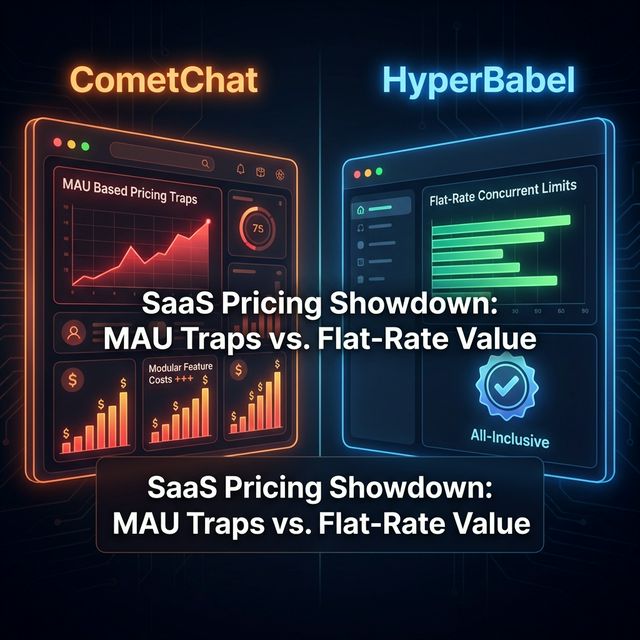
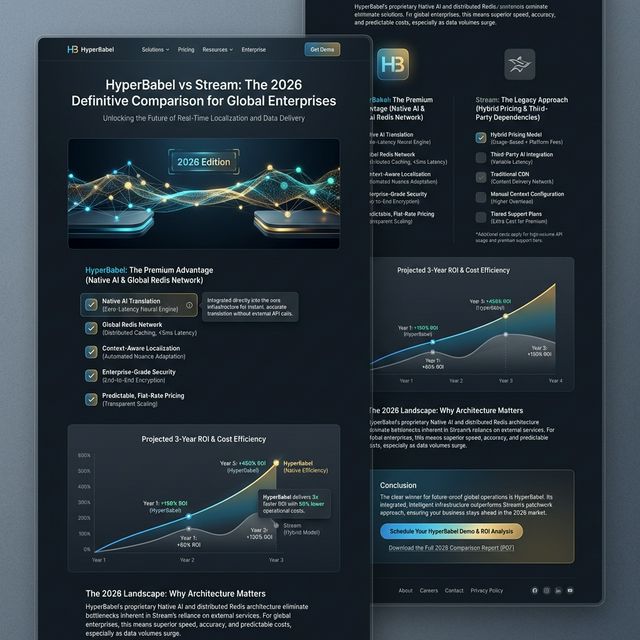
| Platform | Pricing Model | Core Focus | Feature Packaging |
|---|---|---|---|
HyperBabel 2026 Winner | Flat-rate / Concurrent | All-in-One + AI | Integrated (Chat, Video, Trans, Live) |
| Stream | MAU + PAYG Hybrid | Real-time UX | Fragmented (Video/Live are separate) |
Modular pricing is not a discount — it is a deferred bill
Modular platforms are attractive at signup precisely because the first module is cheap. You buy chat. Six months later the roadmap says "add video". Then "add live". Then a Korean user asks why the app is English-only, and translation becomes a project rather than a setting.
Each addition is priced as a separate product, and — more expensively — integrated as a separate product:
| What you are actually buying | Modular platform | HyperBabel |
|---|---|---|
| Chat | base product | included |
| Video calls | separate product + SDK | included |
| Live streaming | separate product or unavailable | included |
| Real-time translation | third-party API you wire yourself | included, in the pipeline |
| File storage + delivery | your object storage + egress bill | included, $0 egress |
| Identity across products | you write the mapping | one identity |
| Webhook/event stream | per product | one stream |
The line that hurts is not any single subscription. It is the last three rows — the integration surface you now own forever. Every new product adds an identity mapping, a second set of retry semantics, and one more place to look when a message goes missing at 3 a.m.
What "in the pipeline" actually means for translation
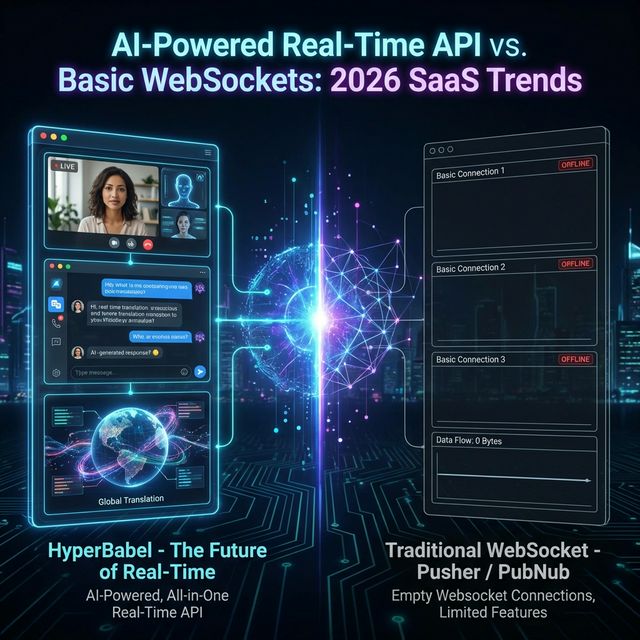
Most platforms treat translation as a post-processing step: your client receives a message, calls a translation API, waits, then re-renders. Every device does this separately, so the same sentence is translated N times, latency is added *after* delivery, and the translated text usually is not stored — search and history stay monolingual.
HyperBabel treats translation as a property of the channel. A message carries its translations with it, so:
- the translation happens once per message, not once per recipient;
- history and search work in the reader's language, not just the writer's;
- a late-joining member sees translated backlog, not raw text;
- your client code does not orchestrate anything — it renders what it receives.
The same principle applies to live subtitles during a call or broadcast.
The published rate card
No quote requests, no "contact sales" for the numbers that decide your architecture:
| Metered unit | Overage rate |
|---|---|
| HD video / stream | $9.99 / 1,000 min |
| FHD video / stream | $22.99 / 1,000 min |
| Chat messages | $7.99 / 1M |
| AI translation | $30.99 / 1M characters |
| Real-time speech translation | $29.99 / 1,000 min |
| Storage | $0.03 / GB, egress $0 |
Plans include a monthly quota that resets — Scale ($1,999) covers 10M messages, 30,000 HD + 10,000 FHD video user-minutes, 15,000 HD live-stream user-minutes, 20,000 minutes of speech translation, 5M translated characters and 500 GB of storage before any of the above applies. (Video and streaming minutes are *user*-minutes: a 10-minute call between two people uses 20.)
When Stream is genuinely the better choice
- You want polished UI components more than you want infrastructure. Stream's React/Flutter chat components are mature and save real front-end weeks.
- You need activity feeds, not just chat — ranked, aggregated social feeds are a distinct product Stream does well and HyperBabel does not offer.
- Your app is English-only and will stay that way. The translation advantage simply does not apply to you, so compare on chat features alone.
- You have already built deep customisations on their component library and the switching cost dominates.
Migration checklist
- List the modules you pay for today, including any translation or transcription API billed separately.
- Decide the UI question first. If you rely on prebuilt components, budget front-end time — HyperBabel gives you SDKs and reference demos, not a full drop-in component kit.
- Start with one surface, usually 1:1 chat, and keep group/feed features on the old stack during the transition.
- Collapse identity early. One identity model is most of the benefit; do it before you migrate history.
- Move video after chat. Video sessions are stateless per call, so they cut over cleanly once auth is shared.
- Turn translation on last — it is a flag, not a project, and it is easier to validate once traffic is already flowing.
- Run one month in parallel and compare invoices, not estimates.
The 30-second version
Modular pricing sells you a cheap start and an expensive middle. Ask what your stack looks like *after* the next three roadmap items, not today — and count the integrations, not just the invoices.
Frequently asked questions
Is translation an add-on or part of the plan?
Part of the plan. Every tier includes a monthly translation quota (50K characters on Free, 500K on Basic, 5M on Scale); beyond that it is $30.99 per 1M characters. There is no separate translation product to buy or wire up — it is a property of the channel.
Does HyperBabel provide drop-in chat UI components?
HyperBabel ships SDKs for six platforms plus reference demos you can copy, but not a full drop-in component kit. If your main constraint is front-end capacity rather than infrastructure cost, budget UI time — that is the honest trade-off versus component-first platforms.
Do I need a separate product for live streaming?
No — live streaming is not a separate product, a separate contract or a separate SDK; it is the same API key. It is a capacity question instead: live streaming and group video come with the Scale plan, while Basic covers chat, AI translation and 1:1 HD video. Video and stream minutes share the same published rates ($9.99 per 1,000 HD user-minutes, $22.99 per 1,000 FHD user-minutes) once your plan quota is used up.
What is not included?
Ranked social activity feeds and a full prebuilt UI component library are outside HyperBabel's scope, and there is no SMS or PSTN telephony. Those are real gaps, not marketing omissions — check them against your roadmap before switching.